



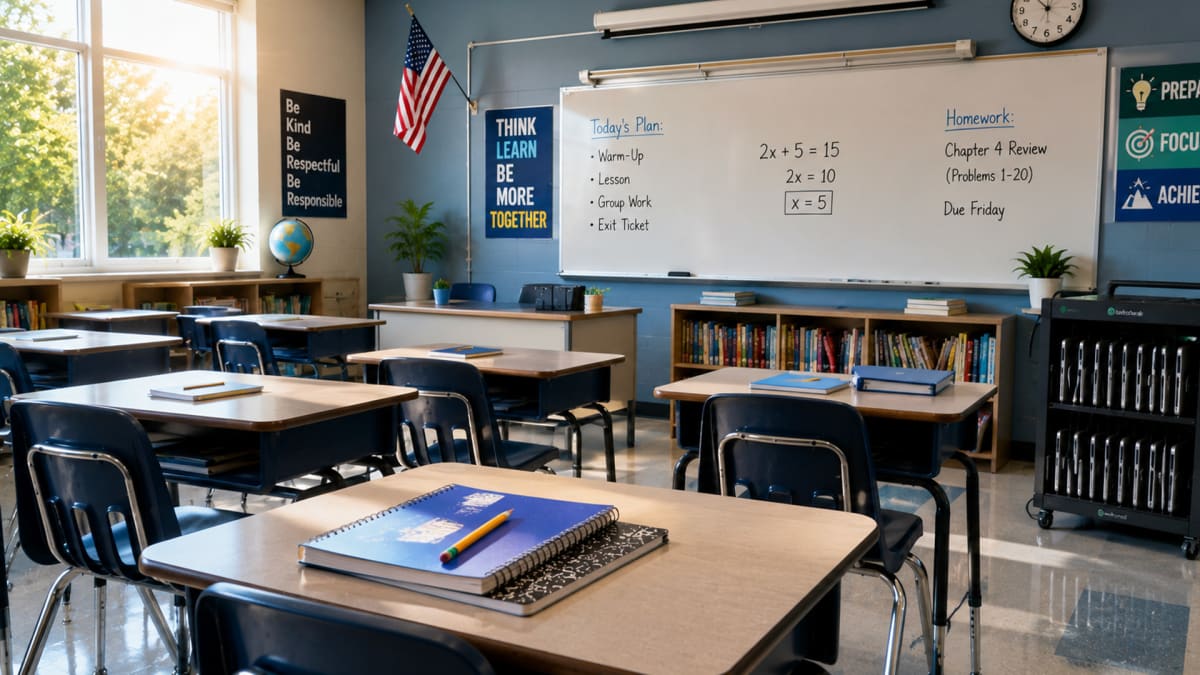
School Starts Without the Scroll!
This year, Georgia’s back-to-school checklist includes pencils, lunch money and one important question: Where will the phone spend the day?
What Bell-to-Bell Really Means
Beginning July 1, 2026, public school students in kindergarten through eighth grade cannot access personal electronic devices during the school day under Georgia’s Distraction-Free Education Act.
Bell-to-bell means from the first bell signaling instructional time through the final bell ending the school day. The rule covers more than phones. Georgia defines a personal electronic device broadly as portable technology capable of communication, internet access, messaging, recording, gaming, social media use or data transmission. That means a connected smartwatch may fall under the policy even when it looks more like a wristwatch than a phone.
The state set the overall restriction, but families should expect procedures to vary. Local systems and public schools were required to establish their own policies covering storage, progressive consequences, off-site activities, monitoring and enforcement. One school may require devices to remain powered off inside backpacks, while another district may use designated storage. The Georgia Department of Education’s message to principals confirms that those local policies had to be adopted before the statewide prohibition took effect.
Call the School, Not the Watch
The most practical first-week change may be communication. Under the legislative requirements for HB 340, parents who need to contact a child during the day should communicate directly with the school. Districts must create emergency systems coordinated by school personnel and explain those procedures to families.
That makes the student handbook, district website and back-to-school email unusually worthwhile reading. Parents should confirm where devices must be kept, whether rules extend to buses or school-sponsored events, what happens after a violation and which office handles urgent messages. It may also help to establish a family plan for forgotten lunches, changed transportation and the other small crises previously solved by text.
The law includes necessary exceptions. A student must be allowed to use a personal device when its use is explicitly required by an IEP, Section 504 plan or medical plan. School-owned instructional technology is also permitted.
Georgia has since approved an expansion of the restriction to high school students, as outlined in the state’s 2026 K-12 education legislation. For families heading into the 2026–27 school year, however, the immediate adjustment belongs to K–8 students.
This year, packing the backpack may begin with deciding what stays home.
Find more educational resources for Georgia families in the directory: https://gbj.com/pre-k-or-kindergarten-schools
